
Key Takeaways
Toyota key replacement in Honolulu can be straightforward when you know which key system your vehicle uses and what information to provide. The right choice depends on the vehicle, urgency, and whether a working key is still available.
- Older metal keys are generally simpler to cut than electronic keys.
- Transponder, remote, and smart keys require different programming steps.
- Losing every key usually involves more work than making a duplicate.
- Mobile service can reduce towing, travel, and dealership wait-time problems.
- A spare key and a fresh fob battery can prevent many avoidable emergencies.
What affects Toyota key replacement cost
The price of Toyota key replacement is shaped by more than the key blank itself. Your Toyota’s year, model, trim level, key system, and current condition all influence the work involved. Location and timing can also matter when a technician needs to travel to a disabled vehicle in Honolulu or elsewhere on Oʻahu.
A useful first step is to identify whether you need a duplicate, a complete replacement, programming, or help with an ignition or lock. The Toyota key replacement cost guide offers another helpful overview of the same pricing questions.
Vehicle year, model, and trim level
Toyota has used several key systems over the years, and the same model name can have different equipment depending on its year and trim. An older vehicle may use a plain metal key, while a newer version may use a transponder, remote head key, or smart key fob.
That difference affects both the parts and the programming process. Giving the technician the exact year, model, and trim helps prevent an inaccurate estimate and makes it easier to bring the correct key or fob.
Existing key versus all keys lost
A duplicate made from a working key is usually a simpler job than replacing every key that has been lost. When no original remains, the technician must identify the vehicle’s key system, create a compatible key, and program it to the vehicle.
All-keys-lost service may also take longer if the vehicle uses a push-to-start system. Even so, a mobile automotive locksmith can often work at the vehicle’s location instead of requiring the owner to arrange a tow first.
Cutting, programming, and additional repairs
A metal blade may only need accurate cutting, but an electronic key can require cutting and programming before it will start or communicate with the vehicle. A damaged ignition, broken key fragment, or malfunctioning lock adds another layer of work.
The most useful quote separates those parts clearly. Ask for the complete scope before approving service so you understand whether the estimate includes the key, cutting, programming, service call, and any necessary repair.
For a general comparison, these are the usual cost drivers:
| Situation | Main work involved | Why the total can vary |
|---|---|---|
| Working spare needed | Cutting and, if applicable, programming | Key system and replacement part |
| One key lost | Creating a compatible replacement | Vehicle year and electronic security |
| All keys lost | Key generation and full programming | More testing and programming work |
| Damaged ignition or lock | Repair, extraction, or replacement | Condition of the vehicle hardware |
The table is a guide rather than a fixed price list. An exact total depends on the Toyota and the condition of its key system when service begins.
Emergency, after-hours, and mobile service factors
A call during a lockout, at night, or in a busy parking area may involve different logistics from a planned duplicate made during regular hours. The technician may need to travel, locate the vehicle, verify ownership, and complete the job where the Toyota is parked.
Mobile service can still be less expensive overall when it avoids towing and dealership transportation. For additional context on comparing locksmith pricing and hidden charges, see this Honolulu locksmith cost advice.
Toyota key types and their replacement requirements
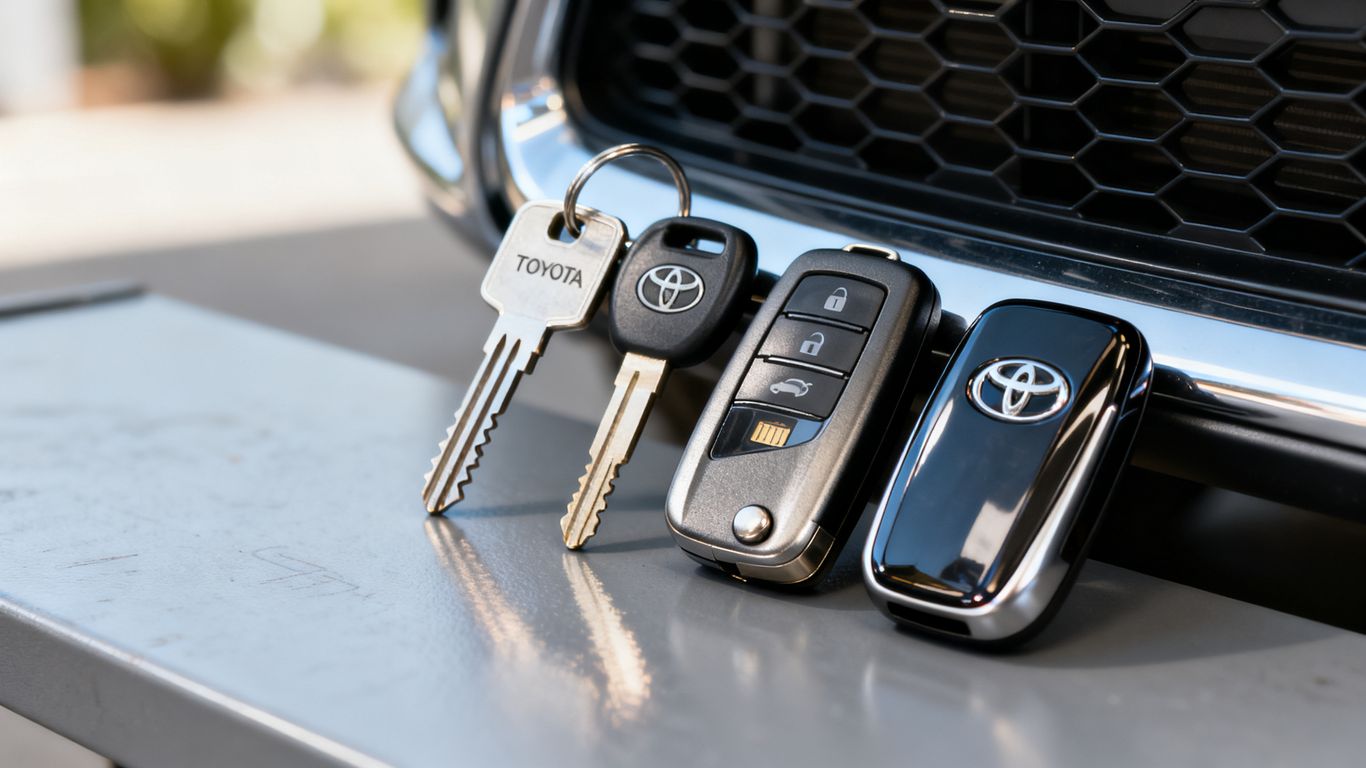
Toyota keys range from basic blades to electronic smart fobs that communicate with the vehicle. The outward appearance of a key does not always reveal how much technology is inside it. Knowing the type helps explain why two Toyota owners may receive very different replacement estimates.
The key system also determines whether the job can be completed by cutting alone or requires specialized programming and testing.
Traditional metal keys for older models
A traditional metal key has a mechanical blade that fits the vehicle’s locks and ignition. It is usually the simplest Toyota key to replace because there is no remote or immobilizer chip to pair.
The blade still needs to be cut precisely. If it is worn, bent, or copied from a damaged key, the new key may fit poorly or turn roughly, so the technician should check the condition of the lock and ignition as well.
Transponder keys and immobilizer programming
A transponder key may look much like a traditional key, but it contains a chip that must communicate with the Toyota’s immobilizer system. Cutting the blade alone does not necessarily make the vehicle start.
Programming connects the replacement key to the vehicle’s security system. If the original key is missing, the technician may need to identify the correct transponder system and complete the programming without an existing working key.
Remote head keys with integrated buttons
A remote head key combines a physical blade with buttons for functions such as locking and unlocking. The replacement must work mechanically in the ignition or door and electronically through the remote functions.
That means the technician needs to test both sides of the key. A blade that turns but a remote that does not respond is not a complete replacement.
Smart keys and push-to-start fobs
Smart keys and push-to-start fobs use proximity technology rather than a conventional blade for everyday starting. They are generally more technical to replace because the fob must be electronically paired with the vehicle.
A weak battery can sometimes imitate a larger failure, but a lost or damaged fob may need replacement and programming. The Toyota key fob replacement guide explains why model year, source, and programming affect the overall cost.
How the Toyota key replacement process works
A professional replacement begins with information gathering, not with immediately cutting a blank. The technician needs to understand where the Toyota is, what happened to the key, and which key system the vehicle uses. That preparation helps reduce delays and avoids bringing the wrong part or equipment.
The process may be completed on-site, but the exact time depends on the vehicle and programming requirements.
Providing your vehicle and location details
When requesting service, have the Toyota’s year, model, and exact location ready. The VIN, found on the dashboard or vehicle documents, can also help confirm the correct key system.
Be specific about whether the key is lost, locked inside, broken, damaged, or simply no longer responding. A parking garage level, nearby landmark, or clear address can make it easier for a mobile technician to find you.
Verifying ownership and identifying the key system
Automotive key work involves the vehicle’s security system, so the technician should verify that you are authorized to request service. Registration, identification, or other ownership information may be requested before work begins.
Cutting and programming the replacement key
Once the system is identified, the replacement blade can be cut when a blade is involved, and the electronic component can be programmed when required. Double Quick Locksmith describes its automotive service as on-site cutting and programming for Toyota keys and fobs, including smart keys and transponder keys.
If every key has been lost, the technician may generate and program a new key at the vehicle. The work is more involved than copying a working key, but it does not automatically mean the vehicle must be towed.
A practical call usually follows this sequence:
- Confirm the vehicle year, model, trim, and VIN.
- Explain whether a working key is available.
- Share the vehicle’s exact location and access conditions.
- Ask what cutting, programming, or repair work the estimate includes.
Having these details ready helps the technician prepare for the correct key system. It also gives you a clearer basis for comparing service options.
Testing the ignition, locks, remote, and start functions
Replacement is not finished when the key is merely cut or the fob lights up. The technician should check the functions relevant to the Toyota, including the ignition, door locks, remote buttons, immobilizer communication, and push-to-start operation when applicable.
Testing at the vehicle gives you a chance to report a problem immediately. It is much easier to correct a programming or fit issue before the technician leaves than after the vehicle is parked elsewhere.
Choosing between a mobile locksmith and a dealership
Both a mobile automotive locksmith and a dealership may be able to replace a Toyota key, but the experience can be very different. A dealership generally works through its service department and manufacturer systems, while a mobile locksmith comes to the vehicle.
The better choice depends on urgency, vehicle requirements, warranty circumstances, and the total cost after transportation is included.
When mobile locksmith service is more convenient
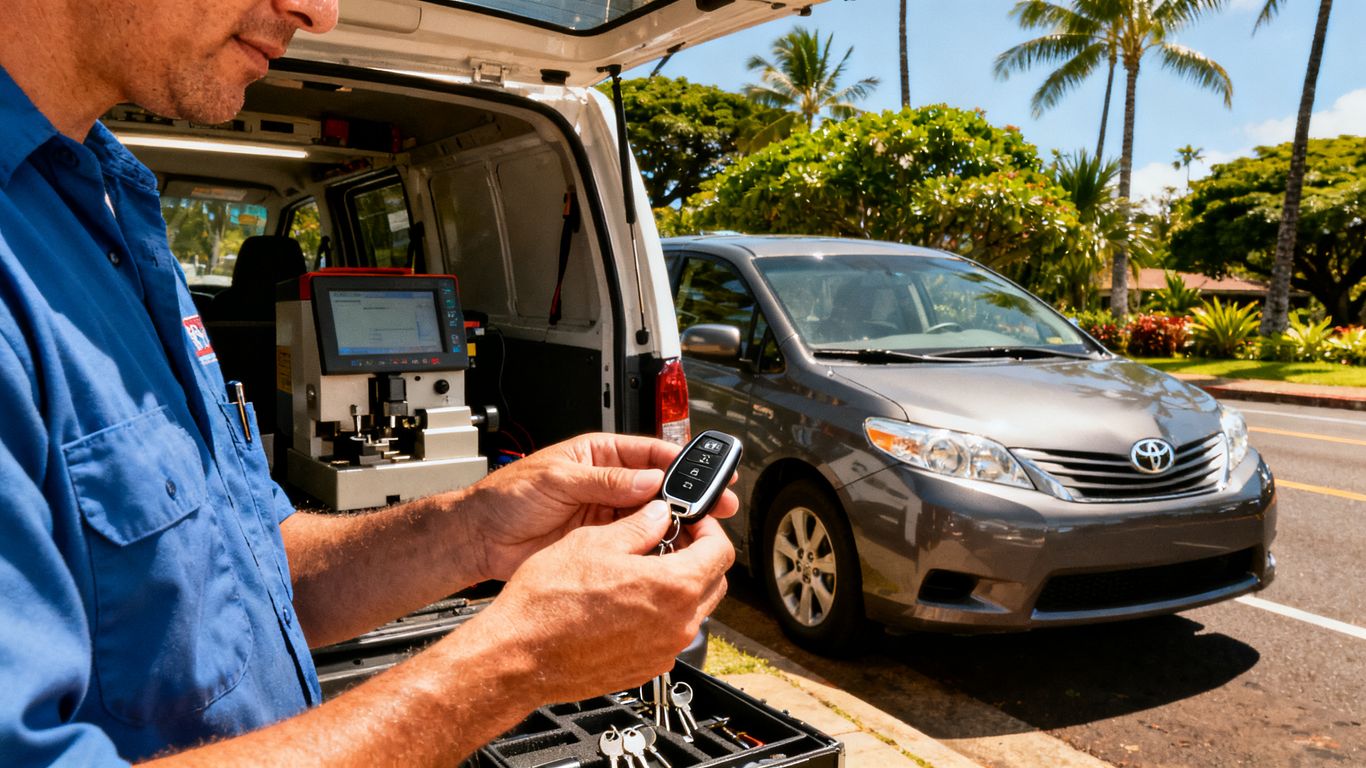
Mobile service is useful when the Toyota is parked at home, work, a shopping center, or a roadside location. Double Quick Locksmith provides 24/7 mobile automotive service across Oʻahu, so the vehicle does not necessarily need to be driven or towed to a shop.
This can be especially practical when all keys are lost or the vehicle will not start. The technician can assess the key system, cut and program a replacement on-site when supported, and test the result at the vehicle.
Situations that may call for a dealership
A dealership may be a sensible option when a vehicle requires manufacturer-only programming, when a factory-issued replacement is a priority, or when warranty or recall support applies. Newer vehicles can have requirements that should be confirmed before choosing a service provider.
It is worth asking the dealership whether the key is in stock, whether an appointment is required, and whether the vehicle must be present for programming. Those details affect the real wait and total cost.
Comparing towing, wait times, and total costs
A dealership quote is only one part of the comparison if the Toyota cannot be driven. Towing, transportation, appointment availability, and time away from work can all change the final burden.
Compare the complete picture rather than the price of the key alone. These questions usually clarify the difference:
- Does the quote include cutting and programming?
- Is a service call or after-hours charge included?
- Will the vehicle need to be towed?
- What testing or warranty is provided after the key is programmed?
Once those details are clear, a lower quote is not automatically better, and a higher quote is not automatically more complete. The useful comparison is the total cost for a working, tested key.
Risks and limitations of online and DIY options
Online keys and fobs can appear inexpensive, but compatibility is not guaranteed. Some aftermarket parts may lack full functionality, and newer push-to-start systems often cannot be programmed through simple owner procedures.
Roadside assistance may unlock the vehicle without providing complete key cutting or programming. DIY attempts can also damage a lock or create additional security-system problems, so professional help is usually safer when the original key is unavailable.
Toyota models and services commonly supported
Toyota models can use different key systems across years and trim levels, even when the model name remains the same. That is why a technician should identify the vehicle rather than relying only on a general model list.
Common requests include duplicates, lost-key replacement, fob replacement, transponder programming, and ignition-related assistance.
Replacement keys for Camry, Corolla, and Avalon
Camry, Corolla, and Avalon owners may need anything from a conventional replacement key to an electronic remote or transponder key. The correct service depends on the specific year and equipment rather than the model name alone.
A working spare can often simplify future duplication. If no key remains, provide the VIN and vehicle location so the key system can be assessed before the technician arrives.
Key and fob services for RAV4 and Highlander
RAV4 and Highlander models are commonly found with electronic keys and fobs, although the exact system varies by year and trim. A replacement may therefore involve both a physical component and programming.
If the fob still unlocks the vehicle but will not start it, or if the buttons have stopped responding, describe those symptoms clearly. They may point to a battery issue, damage, or a programming problem rather than a completely lost key.
Tacoma, Tundra, and 4Runner key replacement
Tacoma, Tundra, and 4Runner owners may request traditional keys, transponder keys, remote head keys, or smart fobs depending on the vehicle configuration. Trucks and SUVs are not limited to one key style across every production year.
A replacement should be matched to the exact vehicle and tested before the job is complete. This is particularly helpful when the key is used for both mechanical entry and remote functions.
Prius, Sienna, and other Toyota models
Prius, Sienna, and other Toyota models can also have varied key requirements across generations. Hybrid systems and push-to-start equipment may make correct fob identification especially important, but the basic service questions remain the same.
Double Quick Locksmith lists Toyota among the vehicles it services and describes replacement, duplication, and on-site programming for many Toyota key types. A technician can confirm whether the requested service is supported after reviewing the model, year, VIN, and key symptoms.
How to avoid future Toyota key problems
The easiest key emergency to manage is the one planned for in advance. A spare key, a working fob battery, and sensible storage habits can reduce the chance of being stranded.
If a key is stolen rather than merely misplaced, security should also be considered. The goal is not only to regain access but to make sure the vehicle remains protected.
Making a spare before losing your last key
Making a spare while one working key is available is usually simpler than replacing every key from scratch. It also gives another household member or trusted driver a way to use the Toyota if the main key disappears.
Store the spare somewhere secure and separate from the everyday key. A duplicate made before an emergency can save time when you are far from home or dealing with a busy schedule.
Replacing a weak or dead key fob battery
A fob that works inconsistently may have a weak battery rather than a failed electronic system. Many Toyota fobs use a small coin-cell battery, but the correct size should be confirmed from the existing fob or owner’s information.
Replace the battery carefully and test the buttons near the vehicle. If the fob still does not unlock or start the Toyota, it may need diagnosis, reprogramming, or complete replacement.
Protecting keys from water, heat, and physical damage
Keys and fobs are easy to damage in beach bags, pockets, cupholders, and hot vehicles. Keep them away from water, excessive heat, heavy pressure, and objects that can bend or crack the housing.
A protective case can reduce everyday wear, but it cannot fix a key that has already been damaged. If the blade is bent or the buttons are breaking, arrange a replacement before the key stops working completely.
Deactivating lost or stolen keys to protect your vehicle
A lost key is inconvenient; a stolen key can create a security concern. Ask a qualified automotive professional whether the missing key can be removed from the vehicle’s authorized-key memory and whether a replacement should be programmed.
The right procedure depends on the Toyota’s year and security system. Do not assume that changing the fob battery or locking the doors has deactivated a lost electronic key.
Conclusion
Toyota key replacement in Honolulu is easier to plan when you identify the key type, gather the VIN and location, and compare the full cost of mobile service with towing and dealership delays. If you need help at the vehicle, contact Double Quick for mobile locksmith service and ask for a clear explanation of the cutting, programming, and testing involved.
Frequently Asked Questions
How much does Toyota key replacement cost?
The cost depends on the Toyota’s year, model, trim, key type, programming requirements, location, and whether additional repairs are needed. A duplicate made from a working key is often less involved than an all-keys-lost replacement.
Can a Toyota key be replaced without the original?
In many cases, yes. A qualified automotive locksmith can identify the vehicle’s key system, create a compatible replacement, and program it to the vehicle when the required equipment and procedures are supported.
How long does Toyota key replacement take?
Timing varies by vehicle and key type. A basic duplicate may be quicker, while an all-keys-lost situation or smart-key replacement can take longer because of additional identification and programming steps.
Is a dealership required for a Toyota smart key?
Not always. Some smart-key replacements can be completed by a properly equipped automotive locksmith, while certain manufacturer-specific situations may require dealership systems or support.
What information should I provide when requesting service?
Provide the Toyota’s year, model, trim if known, VIN, exact location, and a description of the problem. Also explain whether you have a working key, a damaged key, or no key at all.
Will a new Toyota key work immediately after it is cut?
A mechanical key may work after accurate cutting, but a transponder, remote head key, or smart fob may also require programming. The ignition, locks, remote buttons, and start function should be tested before service is finished.
Should I make a spare Toyota key?
Yes, making a spare while you still have a working key can make a future replacement simpler. Keep it in a secure, separate location and replace the fob battery when it begins to show weak or inconsistent operation.